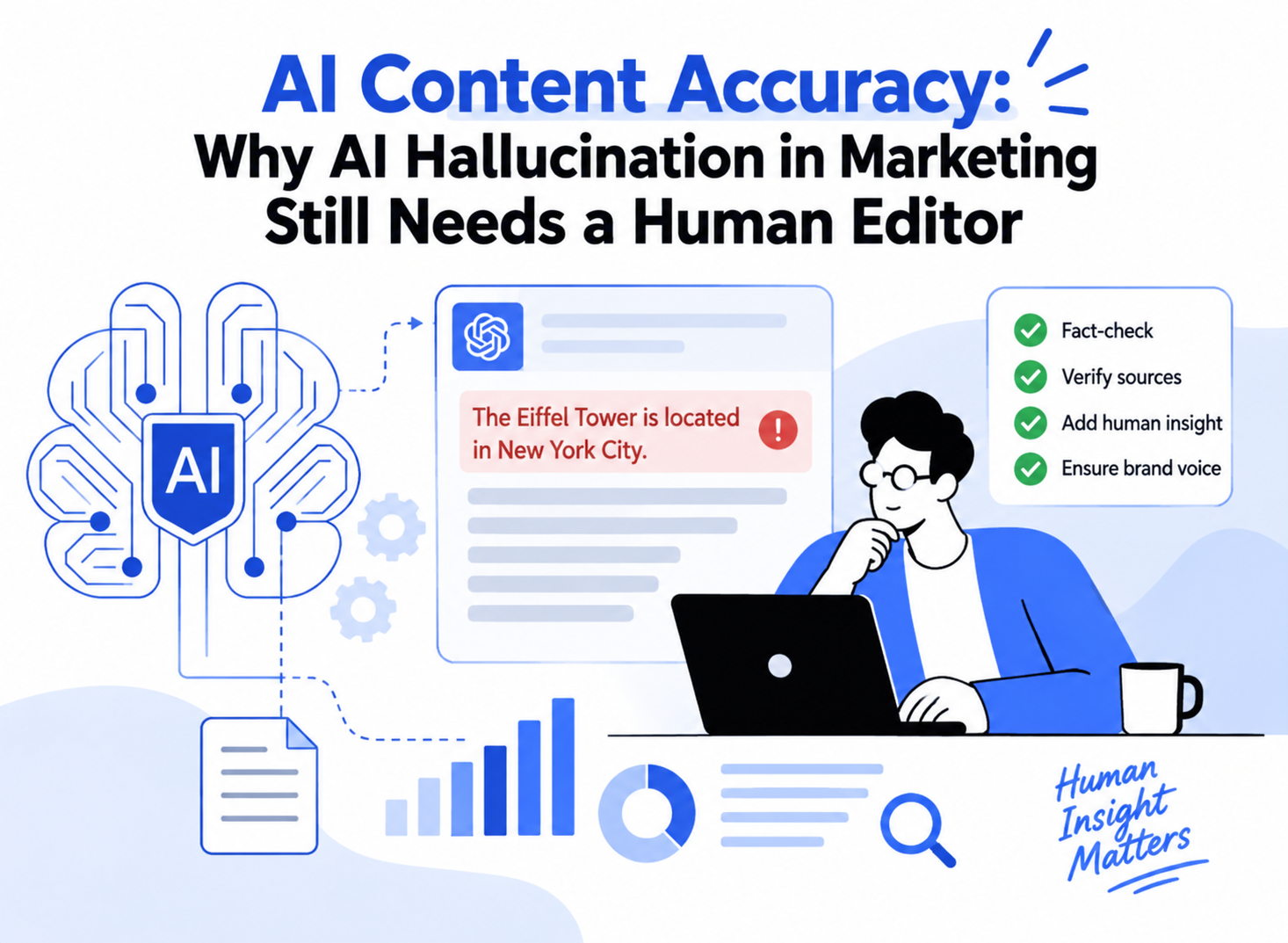
AI Content Accuracy: Why AI Hallucination in Marketing Still Needs a Human Editor
You've probably had this moment. You ask ChatGPT, Claude, or Gemini for something. It comes back fast, sounds confident, reads clean. And then, a few minutes later, you realize half of it is wrong.
That's AI hallucination in marketing, and it's not bad luck. It's just how these tools work right now - which is exactly why AI generated content risks have become a real conversation among marketing teams, not just a tech-forum topic.
A recent industry study ran hundreds of prompts through six major AI platforms and, separately, surveyed hundreds of working marketers about how often AI gets things wrong in their actual day-to-day jobs. Not a lab test. Real workflows. And honestly, the numbers are a decent gut-check for anyone - us included - thinking seriously about AI content accuracy.
The Numbers, Roughly
Close to half the marketers surveyed said they run into inaccurate AI output several times a week. Not once in a while. Several times. Weekly.
And more than seven in ten said they're spending real hours - several a week, give or take - just fact-checking what the AI handed them.
Here's the part that stings a bit more: over a third admitted that hallucinated or incorrect content had actually gone live. Published. Public. Before anyone caught it. Usually because of a false fact, a source link that led nowhere, or language that just didn't fit the brand.
When the researchers tested the platforms head-to-head, no tool came out completely clean. The best performer landed fully correct answers roughly six times out of ten. Even the most consistent model - the one that made the fewest outright mistakes - still slipped up somewhere around one in sixteen responses, mostly by leaving something out rather than inventing it. Others weren't so careful. Fabricated facts. Self-contradictions in the same answer. Confident-sounding numbers that were just... old.
Where AI SEO Content Risks Actually Show Up
Not every task carries equal risk here.
Structured, technical output - HTML, schema markup, full long-form articles - turned out to be far more error-prone than loose brainstorming. Makes sense when you sit with it for a second. More precision needed means less room for a model to quietly fudge a gap and hope nobody notices.
A few tells kept showing up across the board:
- A source or citation that looks real but leads nowhere (or doesn't exist at all)
- A response that answers a slightly different question than the one you actually asked
- Big, sweeping claims with zero specifics attached - no date, no source, nothing
- Two statements in the same answer that quietly contradict each other
- A stat that feels a little too clean, too convenient - and has no attribution
If you've spent any time reviewing AI drafts, at least one of those will feel familiar.
AI vs Human Content Quality: What Actually Closes the Gap
None of this means ditch the tools. The efficiency is real, and most marketers in the study said they're willing to tolerate some margin of error for the speed they get in return.
But there's a difference between an acceptable margin and content going live unchecked. This is where content fact-checking AI output - not just trusting it - makes the real difference in quality.
At Eaglemount, drafts don't skip the human step. Every AI-assisted piece gets looked at by a person before it lands on a client's site, ad account, or report - no exceptions. A few habits carry most of that weight, and honestly they're not complicated:
- Check every source before it's cited. Link or study reference shows up? Click it first. Just because it reads convincingly doesn't mean it's real.
- Tighten the prompt. Vague instructions give the model more room to guess - and guessing is where hallucinations start.
- Don't skip the review pass, especially on technical stuff like schema, metadata, or anything with a number attached to it.
- Treat AI output as a first draft. Not the final one. Someone still needs to own what actually ships.
The Takeaway on AI Content Marketing Best Practices
AI genuinely earns its place in a modern content operation. But the data's pretty clear - even the strongest tools still get things wrong often enough that it matters.
The teams getting the most out of AI right now aren't necessarily the ones using it the most. They're the ones who built a real AI content review process around it, and stuck to it.
That's the bar we hold our own content to.
Ready to Scale Content Without the Guesswork?
AI can speed up your content pipeline - but only if there's a system behind it catching errors before your audience does. Eaglemount Technologies builds that system: AI-assisted drafting, backed by human review, fact-checking, and SEO strategy that actually holds up.
Get in touch with our team to audit your current content workflow and build one that scales safely.