Digital Marketing vs Traditional Marketing: What Works for Australian Businesses in 2026
Picture a café owner in Brunswick who decides flyers are a waste of money because everyone's glued to their phones anyway. She stops the letterbox drops, puts the saved cash into Instagram, and for a few weeks things look fine. Then the weekday trade from the surrounding streets slowly dries up and she can't quite work out why. Plenty of local businesses go through something like this, and it usually comes down to cutting one channel without really knowing what it was quietly doing for them.
That's the heart of the digital marketing vs traditional marketing question. It's rarely about which one is better in the abstract. It's about what your customers do before they pick up the phone or walk through your door, and whether you're actually there at those moments.
So which one should you pick?
Neither, exclusively. Digital marketing tends to be easier to measure and cheaper to get going, while traditional marketing still carries a kind of trust that's hard to fake with a banner ad. Most Australian businesses that seem to be doing well in 2026 are running both, though almost never in equal parts, and the balance shifts quite a lot depending on what you sell and who's buying.
Where traditional marketing still earns its keep
It's tempting to write off print, radio and signage as relics, and we'd gently disagree. A tradie ute parked outside a job with a big phone number on the side gets seen by every neighbour on that street, and a footy club sponsorship gets your name mentioned at the pub on Saturday arvo, which is not something a click-through rate will ever tell you.
Local trust is the big one. People are more relaxed about calling a business they've seen around their suburb for years.
Older customers are another reason. Plenty of people past sixty still read the local paper and have talkback radio on in the kitchen, so if they're your buyers, skipping those channels is a real risk.
Bigger purchases like kitchens, funerals or financial advice often start with a brochure, a showroom visit or a recommendation from a mate. Those people frequently Google you afterwards anyway, which we'll get to in a minute.
The downside is measurement. You run a radio campaign, the phone rings more, and then you're left guessing whether it was the ad, the school holidays or just a warm week.
Where digital marketing pulls ahead
Every click, call and enquiry form leaves a trail, so you can see roughly what's working and shift your budget within days rather than waiting for the next print run. The people finding you through search are often already halfway to buying too, because someone typing "digital marketing services" or "online marketing Melbourne" into Google is looking for exactly that, which is a very different situation to interrupting somebody mid-scroll.
SEO Services Australia: The Slow Burn That Pays Off
Good SEO is slow. Anybody promising page-one rankings in a fortnight is either lucky or selling something, and realistically you're looking at several months before results become obvious. The upside is that SEO services in Australia keep working after the effort's been put in, so a well-built service page or a genuinely helpful guide can bring in enquiries for years. For local and service businesses it's often the steadiest channel they've got.
Google Ads Australia: Leads When You Need Them
If you need enquiries this month rather than next year, Google Ads in Australia can do it, provided the campaign is set up carefully. We've looked at plenty of accounts where a big chunk of the budget went on clicks from people who were never going to buy, simply because the keywords were too broad or nobody had added negative keywords. A small, tight campaign usually beats a big loose one.
Social Media Marketing Australia: Reach Where People Scroll
Social media marketing in Australia suits retail, hospitality, fitness, beauty and local services particularly well, and short video is doing most of the heavy lifting at the moment. Facebook and Instagram are still useful for local reach, while LinkedIn tends to be where B2B businesses get the most out of their time.
How the two compare in practice
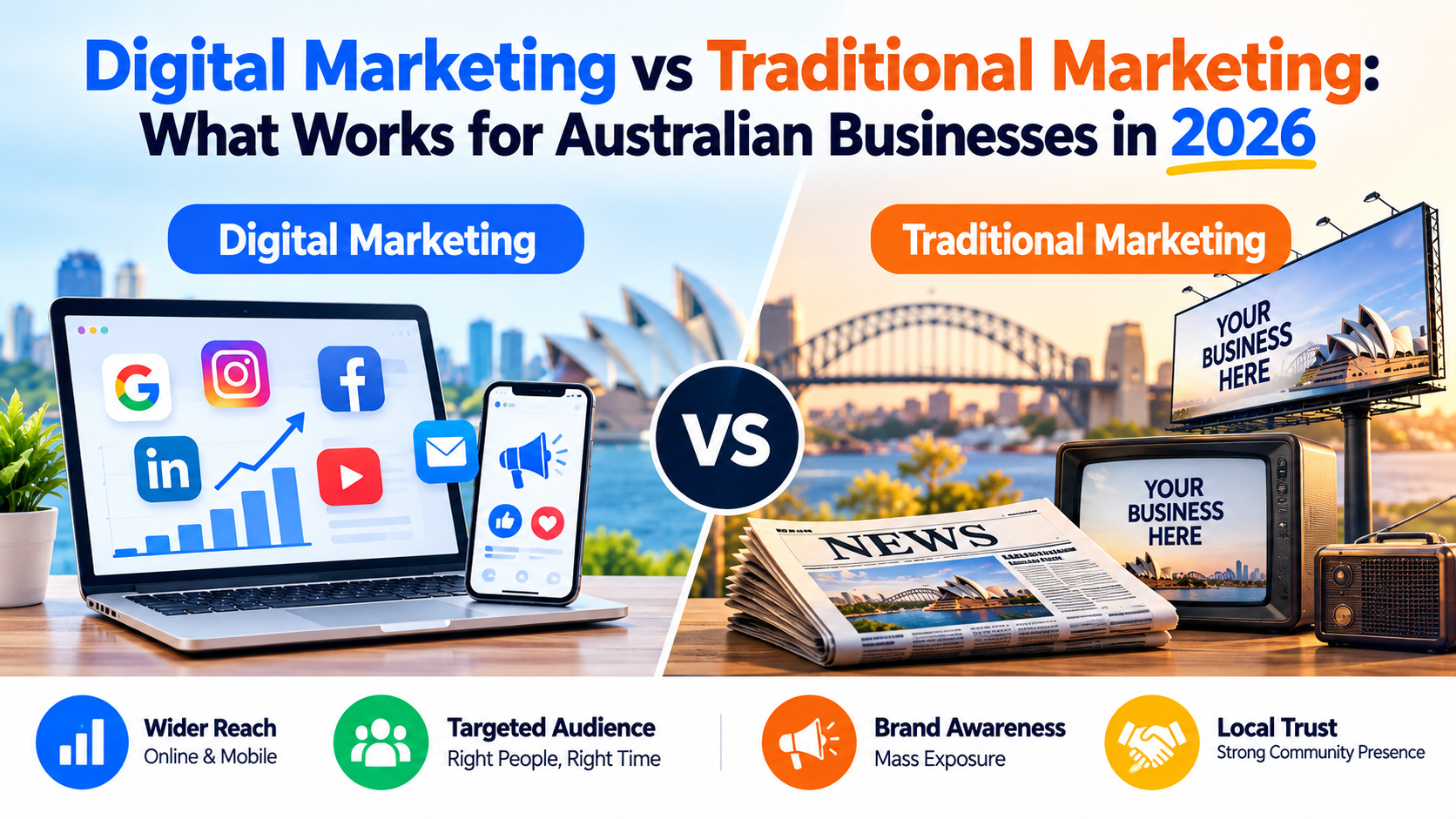
In practice the difference comes down to a handful of things. Digital is usually cheaper to start and lets you test with a small budget, and within days you can see which ads or posts are actually bringing in calls, whereas a radio or print campaign tends to need a bigger commitment up front and gives you much fuzzier feedback. Paid search can move in days, SEO takes months, and traditional media depends on when your slot happens to run.
Where traditional wins is local trust, because a familiar sign or sponsorship builds credibility quickly, while digital trust grows more slowly through reviews, content and just being seen again and again. Targeting is the other big gap: digital lets you aim at a suburb, an age group or even what someone searched for five minutes ago, and traditional is more of a broad net.
So digital tends to suit leads, sales and steady growth, and traditional is better for awareness and a visible local presence. It's less a scorecard than a reminder that each channel does a different job.
What a sensible mix looks like
There isn't a template, but this is roughly how we'd think about it for different kinds of business.
A local trade or service business like a plumber or cabinet maker usually does best leaning digital, with a properly set-up Google Business Profile, some local SEO and a modest Google Ads budget, while keeping the van signage and word of mouth going. Reviews do a surprising amount of quiet work here.
An online shop can be mostly digital, with search, social and email, and only dip into traditional if there's a big launch on.
A B2B company generally starts with LinkedIn, content and SEO, and adds events or trade print only if their buyers actually read it.
A café, restaurant or retail shop needs a real balance: a strong social and Google Maps presence, plus local sponsorships and the in-store experience itself.
If you want a number to start from, something like 70% digital and 30% traditional is a fair first guess for a typical local business, though please treat it as a starting point and adjust once a few months of data come in.
Mistakes we see a lot
- Trying to run five channels at once and doing all of them badly, when one done well would've been better.
- Skipping tracking. If you can't tell which calls came from where, you're guessing, so get GA4 set up properly before spending anything.
- Neglecting the website. Ads and SEO both send people there, and if it's slow or fiddly on a phone, the money's gone.
- Expecting overnight results from SEO or brand work.
- Copying a competitor who may well be getting it wrong too.
Choosing a digital marketing agency in Melbourne
When you're picking a digital marketing agency in Melbourne (or anywhere in Australia, for that matter), a few plain questions go a long way. Who's actually going to do the work? How will results be reported, and how often? What happens at month three if something isn't working? Can they explain what they're doing without hiding behind buzzwords? A decent agency will be happy to answer all of that, and vague answers are usually a sign to keep looking.
So, what works in 2026?
The businesses getting results tend to be the ones that test small, keep what works and drop what doesn't, rather than picking a side in the digital versus traditional argument. They start with their customer and go where that customer already is.
If you're not sure where to start, that's completely fine, and it's the sort of thing we help with.
Want a straight conversation about your marketing? Get in touch with the team at Eaglemount Technologies. We'll look at what you're doing now, tell you what's worth keeping, and explain where a marketing agency in Australia like us can genuinely help, with no pressure and no fluffy pitch deck.