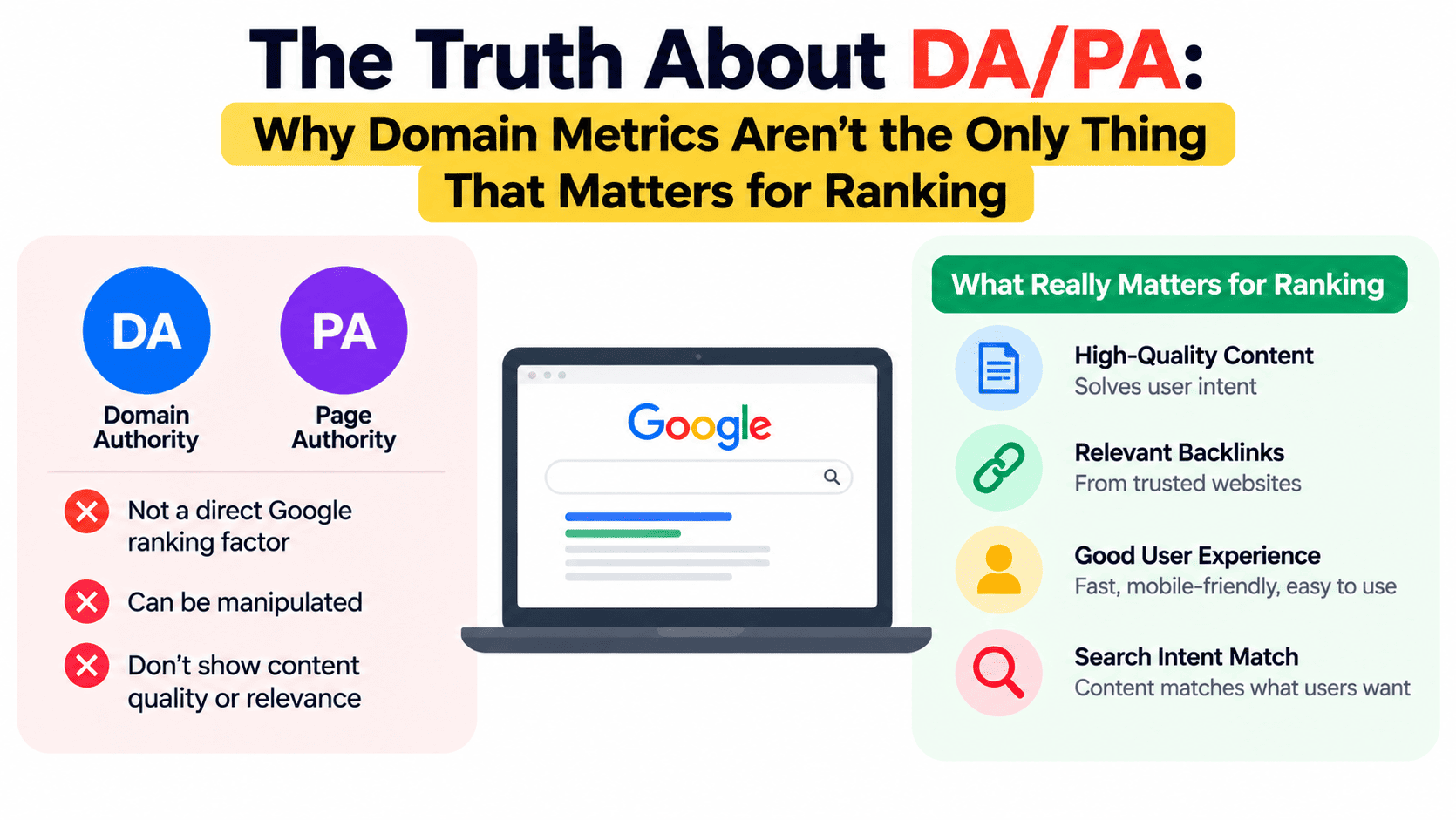
The Truth About DA/PA: What Actually Matters for Google Rankings
Here’s an uncomfortable truth about DA/PA: Google has never used either of them to rank a single page.
Yet agencies still pitch “DA 50+” as a result. Clients still panic when a score drops two points. And plenty of businesses still skip the fixes that would actually grow their traffic, because they’re busy chasing a number that Google doesn’t even see.
It’s an easy trap to fall into. Domain authority looks official. It’s a clean score from 1 to 100, and it often lines up with who ranks well. So it feels like the answer. But a score that reflects strength isn’t the same as a score that creates it.
In this guide, we’ll break down what DA and PA really measure, where they mislead you, and what genuinely moves your rankings, so you can stop chasing the number and start growing your organic traffic.
The Short Answer
DA (Domain Authority) and PA (Page Authority) are scores from Moz. Google doesn’t use them to rank pages. They’re estimates, useful for comparison, and nothing more. A higher score can hint at a stronger link profile, but it doesn’t guarantee rankings.
What DA and PA Actually Measure
Domain Authority is Moz’s prediction of how well an entire website might rank, on a scale of 1 to 100. Page Authority does the same for a single URL.
Both are built mostly on link data from Moz’s own web index. Other tools have their own versions: Ahrefs has Domain Rating (DR), and Semrush has Authority Score. Each uses a different method, so the same site can get quite different numbers in different tools.
That alone tells you something. If three tools disagree about your “authority”, none of them is the real thing.
Is Domain Authority a Google Ranking Factor?
No. Moz itself has said DA isn’t a Google metric, and Google representatives have said for years that they don’t use it (see this Search Engine Land explainer).
Here’s why the myth sticks. Sites with higher DA often do rank better. But that’s mostly because both DA and Google care about similar things, like strong, relevant backlinks. The score reflects those strengths. It doesn’t create them.
Think of it like a thermometer. It shows a fever. It doesn’t cause one.
Where DA and PA Can Mislead You
1. Lower-DA sites outrank higher-DA sites all the time. Search a long-tail query and you’ll often see small, focused sites beating big names. Google ranks pages for queries, not domains for bragging rights.
2. The score can move without your rankings moving. DA can shift because Moz’s index changed or a linking site dropped out of it, even when your content and Google rankings stay put.
3. It’s easy to chase the wrong goal. Some sellers promise to “boost your DA” with bulk links. That can mean spammy placements that raise a number while doing little for real traffic, and sometimes creating risk.
4. It ignores relevance. A link from a high-DA site in an unrelated industry may be worth far less than one from a smaller, closely related site.
What Actually Matters for Ranking
Nobody outside Google knows the full list, but SEO experience and Google’s own guidance point to the same core areas:
- Search intent match. Does your page give people what they came for, in the format they expect?
- Content quality and expertise. Original, helpful, well-structured content, written by people who know the topic, tends to win over time.
- Relevant backlinks. Links still matter. Relevance and editorial quality matter more than a link’s DA number.
- Topical authority. Covering a subject in depth, with connected pages, helps search engines understand what you’re about.
- Technical SEO. Crawlability, indexing, site speed, mobile usability and clean structured data keep good content from getting stuck.
- User experience. If people land and leave straight away, that’s a problem worth fixing no matter your score.
- Brand presence. Being mentioned and searched for across the web builds trust, and may increasingly matter for AI search visibility.
Notice that a third-party score isn’t on this list.
How to Use DA and PA Sensibly
They’re not useless. Use them for what they’re good at:
- Competitor comparison. Gauge relative link strength in your niche, using the same tool every time.
- Shortlisting link opportunities. Treat a metric as one filter. Then check whether the site is relevant, real and actually gets traffic.
- Spotting trends. Watch direction over months, not day-to-day wobbles.
And pair them with metrics that reflect actual results: impressions, clicks and rankings in Google Search Console, plus organic leads and sales in GA4. If DA rises but organic leads don’t, the number isn’t helping your business.
Common Mistakes to Avoid
- Setting “increase DA” as your main SEO goal
- Buying links purely for their DA score
- Ignoring on-page and technical fixes because your DA is “already high”
- Giving up on a keyword because competitors have higher scores
- Comparing numbers from different tools as if they were the same thing
Final Thoughts
DA and PA are a rough sketch of the map, not the territory. Useful for a quick look, risky if you steer by them alone. Build helpful pages, earn relevant links, keep your site technically healthy and measure outcomes that actually pay the bills.
Stop Chasing Scores. Start Growing Rankings That Bring Customers.
Your domain authority is just a number. What your business needs is more visibility, better leads and a clear picture of what’s actually holding your site back.
At Eaglemount Technologies, we go beyond the scores. We look at your content gaps, technical issues, link quality and search intent, then build an SEO plan tied to organic traffic and enquiries, with reporting in GA4 and Looker Studio so you can see exactly what’s working.
In your free consultation, we’ll:
- Review where your site stands against your real competitors
- Spot the biggest ranking blockers beyond DA/PA
- Map out practical next steps you can act on straight away
No jargon. No vanity metrics. Just a clear plan.